
Katz125 Open House event kicked off the school’s yearlong celebration of its 125th anniversary.
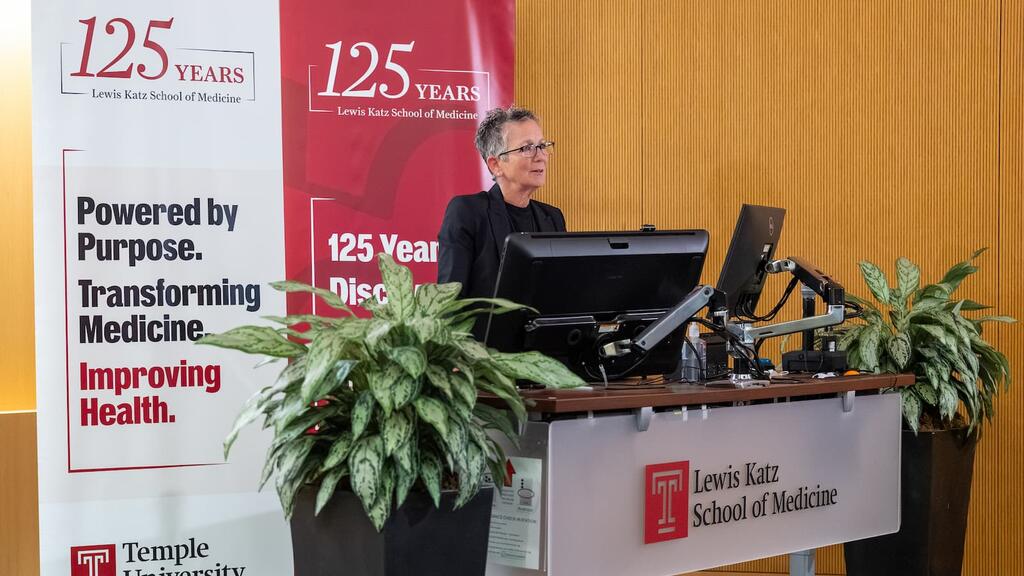
Fatema Hashem was 18 years old when she left Jabriya, Kuwait, where she was born and raised, for Philadelphia, “Temple-bound from day one,” as she said. She traveled to the other side of the world, leaving behind everything and everyone she knew to become a physician, like her father.
Now eight months from graduating from the Katz School of Medicine, Hashem stood before an audience and described, with a lyricism that would have made her mother, a lifelong lover of poetry, beam, how Temple University had embraced her.
Citing several Katz faculty and staff members by name, Hashem said, “It is these names, among many others, that have taught me perhaps the most valuable lesson of my eight years abroad: Home is people, not places. And Temple is not a place; it’s people. And in those people, I have found a home.”
Later, during an interview, she said these sentiments had formed years ago, “and I’ve been trying to find a forum to just say all of that to Temple. And this was the opportunity.”
“This” was Katz Bold Conversations, one of three sessions that comprised the daylong Katz125 Open House, held September 16 at the Katz School’s Medical Education and Research Building (MERB). The event kicked off the school’s yearlong celebration of its 125th anniversary.
A speaker series coupled with a tour of the William Maul Measey Institute for Clinical Simulation and Patient Safety and interactive demonstrations led by its staff were meant to reflect the four pillars of the school’s mission—clinical care, research, education, and community — which Amy J. Goldberg, MD, FACS, the Marjorie Joy Katz Dean of the Katz School, said has remained unchanged over the entirety of the school’s history.
Comprised of brief, five-minute talks that spanned a range of topics, including ongoing research projects; an overview of a new Katz program aimed at helping offset the impending primary care physician shortage; lessons about leadership, running a private practice, embarking on community outreach in North Philadelphia, and providing compassionate gender-affirming care; and several intimate testimonials from students and alumni about how the Katz School shaped them, Bold Conversations was a window into the more inclusive and inspiring culture Dean Goldberg has nurtured since her appointment in 2022 as the school’s first woman dean.
The hour-and-a-half program felt like a mosaic of the different ways people are drawn to the Katz School and the purpose they discover there.
Hashem said she has mixed emotions about her graduation. She’s struggling with the thought of leaving Temple, but she’s also realized the school and its mission are part of her now, and she’ll carry them with her wherever she goes.
“Temple is everything to me,” she said. “I wear it now. I can’t deny it.”
Bringing Medical Education to Life
Late in the morning at the open house, Brittany Peterson performed chest compressions on an adult-size patient simulator, stopping only to check the patient’s vital signs, displayed on a screen just over her shoulder.
For the last year, she’s worked as a clinical research coordinator at the school and often walks by the simulation center, wishing she could venture inside and explore.
“I’m healthcare adjacent most days,” Peterson said. “I see patients, but not every day. And it’s always good to have a skill. I will say intubation is clearly not my calling.”
Earlier, she tried her hand at another of the simulation stations set up around the MERB Commons and it didn’t go well, by her assessment. But here, under the supervision of Jane Cripe, BSMT, Director of Simulation Education, Peterson was thriving. She was happy with the rhythm of her compressions, and the patient responded positively.
Cripe, who has been at Katz for more than 20 years and helped open the simulation center, seemed to relish the chance to interact with Peterson as much as Peterson appreciated the opportunity to indulge her curiosity. “This is an 11-story building, so we see people from the research areas on the elevator, but we don’t really know them,” she said. “I’m glad to see so many of them here today.”
The reason people are here is not by accident
The open house began early in the morning with presentations by three Katz physician-scientists and the four Translational Research Collaboration and Innovation Grant awardees. Two years ago, four pilot grants worth $50,000 each were awarded to multidisciplinary research teams of clinical and basic science faculty to develop practical approaches to treating pressing health challenges and complex diseases.
Innovation was on display again at the day’s final session. In this instance, it was driving a multitude of programs that uplift and empower neighbors in the surrounding community.
“If you want to understand Temple, you have to look at our relationship with our community because serving and partnering with our community isn’t something we added along the way,” Dr. Goldberg said in her introduction to the Community Program Talks. “It’s who we are, and it’s who we always have been.”
Presentations highlighted BUILD Philly, the Lang Medical Scholars Program, SPHERE pathway programs and Temple Health’s comprehensive approach to addressing gun violence. Together, these efforts open doors to healthcare careers, expand access to science and research, and support the health and well-being of surrounding neighborhoods.
Speakers described initiatives that prepare young adults for full-time medical assistant jobs, introduce middle and high school students to healthcare careers, engage college students in research and support first-generation medical students. They also shared how Temple partners with community organizations to promote firearm safety and provide support for people affected by violence that extends beyond the hospital.
For Scott Charles, Trauma Outreach Manager at Temple University Hospital–Main Campus, that work reflects a shared sense of purpose. Over the last two decades, he has worked alongside Dr. Goldberg and community partners to prevent gun violence and support those affected by it.
“When I talk to my counterparts throughout the country, they don’t have the same experience with hospital-based violence intervention programs. They just don’t,” he said. “The reason people are here is not by accident. It’s with intention. They’re up for a challenge. And that’s why this is such a unique place.”