
The study, published in Proceedings of the National Academy of Sciences of the United States of America, deepens understanding of a key mechanism that repairs DNA and helps cancer cells survive.
Photo by Ryan S. Brandenberg
Imagine a cell is a piece of paper on a copy machine, and the words on the page are its DNA. Every time a cell divides, it must copy its DNA, but sometimes its copy machine breaks down. A new Temple study sheds light on how this breakdown is repaired during cell replication.
The research finds a previously unclear mechanism plays a pivotal role in the DNA repair toolkit and how this repair process contributes to cancer growth. The findings also point to a potential avenue for future research into disrupting this DNA repair mechanism to prevent cancer cells from growing.
“We discovered that a protein called PSF3 essentially recruits another protein, Polθ, to a key area in a cell that repairs DNA,” said Tomasz Skorski, director of the Fels Cancer Institute for Personalized Medicine at the Lewis Katz School of Medicine and senior author of the study. “This finding is highly relevant to understanding how genome integrity is maintained in normal and cancer cells. The study may be applicable to leukemias and other cancers and could lead to clinical applications that could selectively kill tumor cells,” he said.
The paper, “PSF3 recruits Polθ to stalled replication forks to promote DNA repair,” was published in the Oct. 19 issue of Proceedings of the National Academy of Sciences of the United States of America.
“The Polθ-PSF3 binding is so critical for cell survival, especially cancer cell survival,” said Skorski. “We want to stop this process. We would eventually like to target this complex with an inhibitor which will disassemble this complex so that Polθ cannot be recruited by PSF3 to this area of the cell where DNA is copied.”
The research was an interdisciplinary collaboration with the Fels Cancer Institute at Katz, Fox Chase Cancer Center at Temple Health, and Temple’s College of Science and Technology (CST). The contributing authors on the study are Umeshkumar Vekariya, associate scientist at the Fels Cancer Institute; Benjamin Lee Prather, graduate research fellow at CST; Rongsheng E. Wang, associate professor at CST; and Roland L. Dunbrack, professor at Fox Chase Cancer Center.
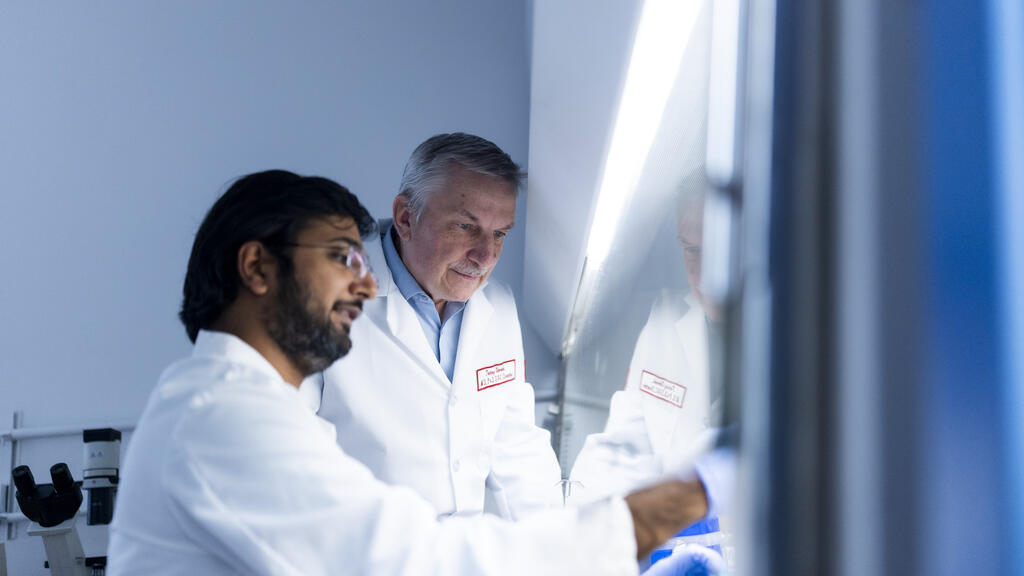
Umeshkumar Vekariya, associate scientist at the Fels Cancer Institute and Tomasz Skorski, director of the Fels Cancer Institute for Personalized Medicine at the Lewis Katz School of Medicine.
Photo by Ryan S. Brandenberg
Cancer cells frequently experience what is known as replication stress because they divide very rapidly. This copying process happens at structures in cells called replication forks, Y-shaped regions of DNA that form where the DNA strands are separated and copied. Cancer cells depend on tools that protect and repair stalled replication forks so that they can keep copying. However, sometimes the copy machinery runs into a jam, creating a stalled replication fork. Cancer cells are especially prone to fork stalling and collapse due to their metabolic alterations producing the abundance of obstacles jamming the forks. If the problem is not repaired, the fork can collapse and produce dangerous DNA breaks. The cell needs a repair crew to get DNA copying back on track.
Polθ is a multifunctional protein that plays a critical role in repairing broken replication forks. Imagine it like calling in tech repair to fix the broken copy machine. The researchers discovered that a protein called PSF3 acts like a dispatcher, directing Polθ, a tech, to the damaged area.
“What we knew is that Polθ has been involved in the repair of replication forks,” said Skorski. “But what we discovered was how Polθ was recruited to the damaged site. With this information, we can do more research to hopefully design and apply a novel class of drugs to target this protein interaction to prevent cancer cells from repairing stalled replication forks.”
Skorski and team found that once at the damaged site, Polθ helps the cell restart stalled DNA replication, essentially restarting the DNA copy machine. The researchers found that Polθ also repairs DNA double-strand breaks that occur when stalled replication forks collapse. In cancer cells without BRCA1 or BRCA2, which are tumor-suppressing genes that help repair damaged DNA and stop cells from growing out of control, Polθ also helps fill gaps in newly copied DNA, providing an alternative way to maintain DNA integrity.
Notably, the team found that the PSF3-Polθ partnership functions in both BRCA1/2-deficient (mutated), and BRCA1/2-proficient (normal), cancer cells.
Skorski is also a professor in the Department of Cancer and Cellular Biology at Katz and a co-leader of the nuclear dynamics and cancer program at the NCI-Designated Fox Chase Cancer Center. His laboratory focuses on the role of DNA repair mechanisms in acute and chronic leukemias and the potential of therapeutic interventions.
The researchers first studied the interaction between the two proteins in cultured cells. To home in on how PSF3 finds Polθ, Skorski and team used computer-based modeling techniques to find where the two proteins would interact. Then, they deliberately changed specific amino acids, or building blocks, in PSF3 to test which ones were important for that interaction. They ultimately found that Polθ binds with a specific part of PSF3, its C-terminal region, which is one end of the protein.
“This finding now presents very exciting potential therapeutic opportunities to explore in the future,” said Skorski. “I get up at 5:45 a.m. every day, excited. This drives me. This is what we do in the lab; this is always our goal. We always think about how we are going to improve a patient’s life and prevent cancers from growing.”